


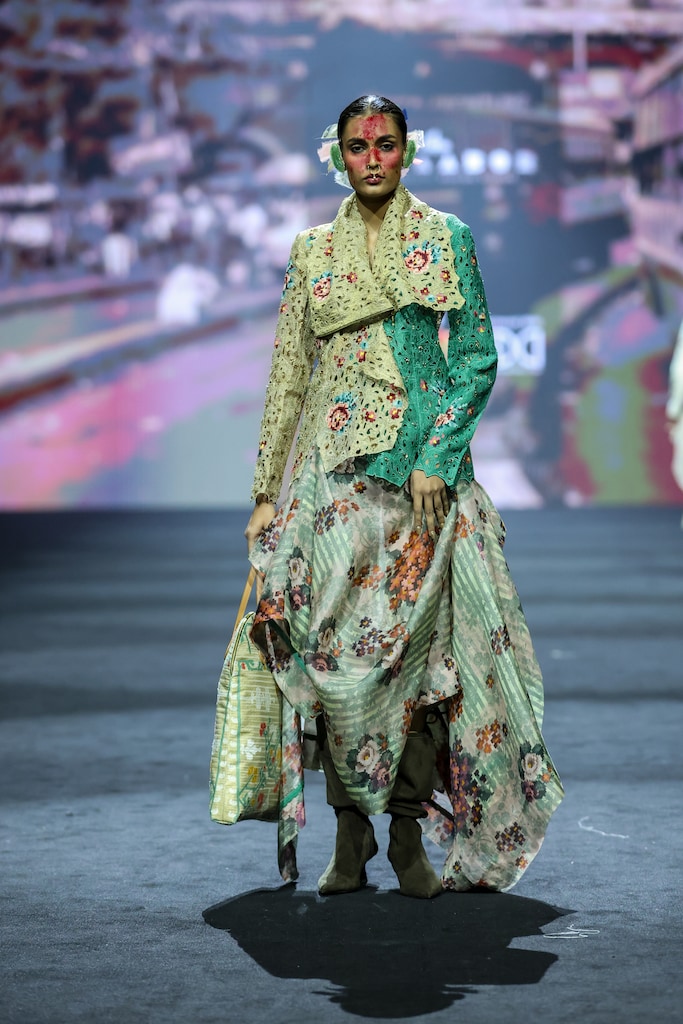
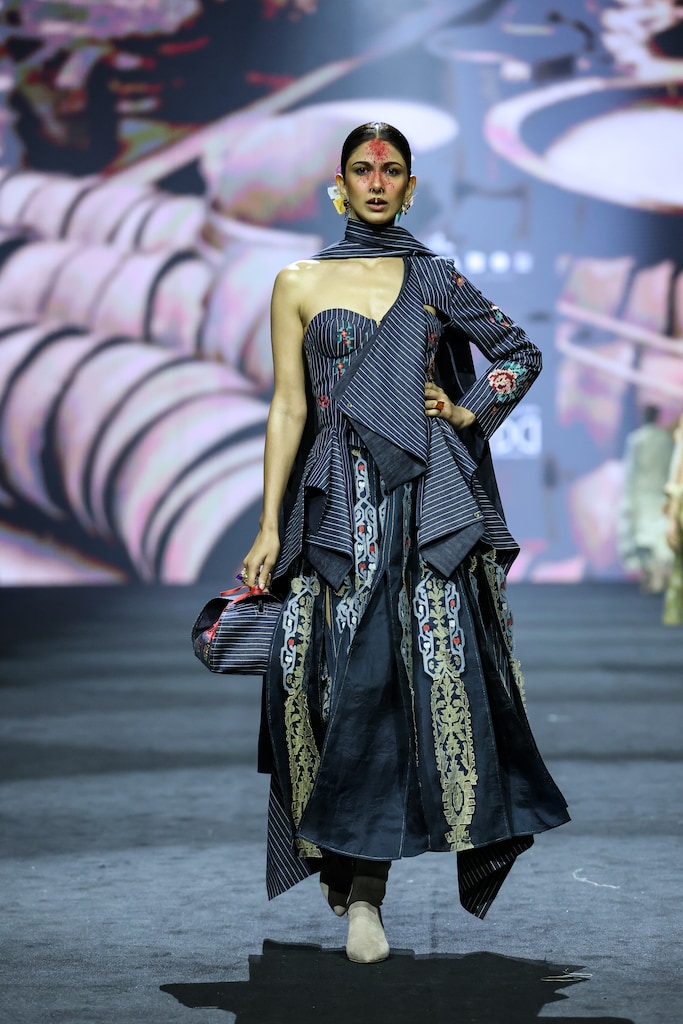
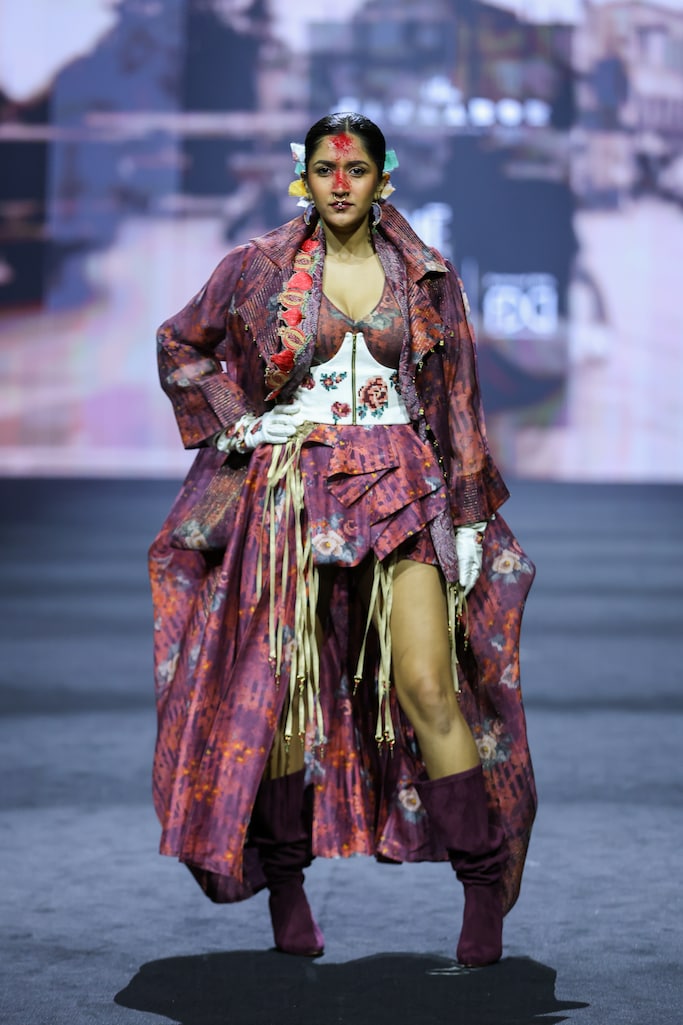
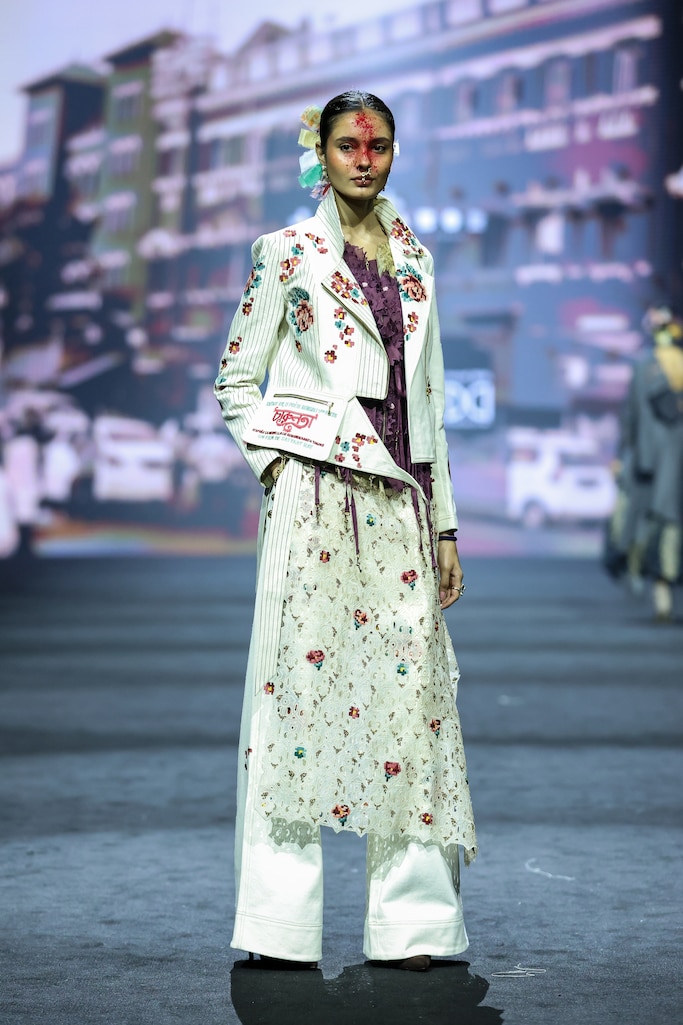
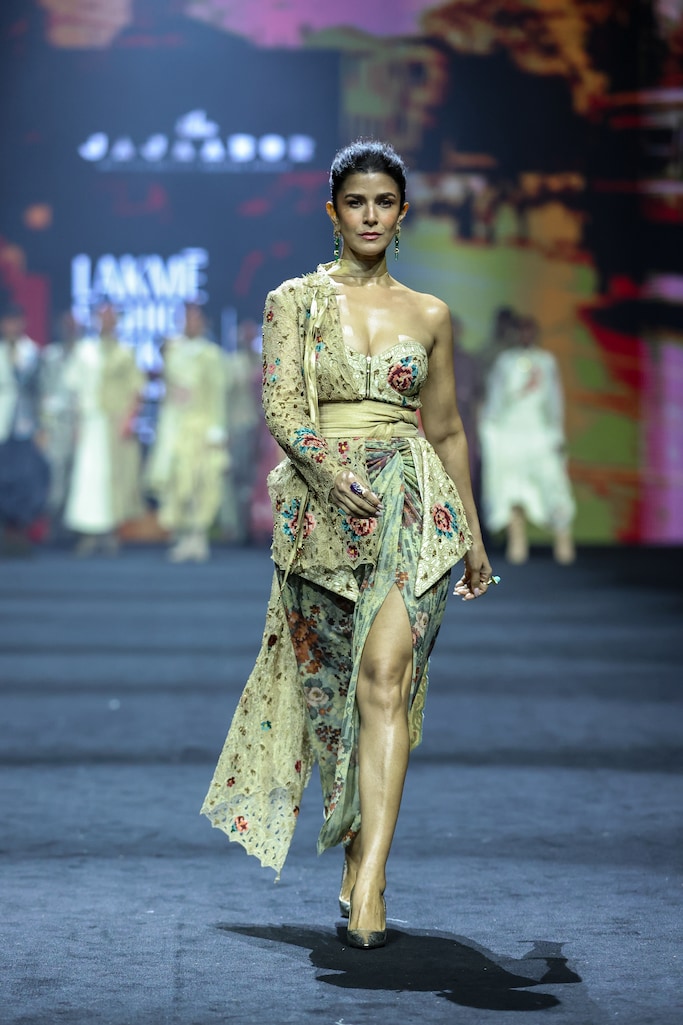
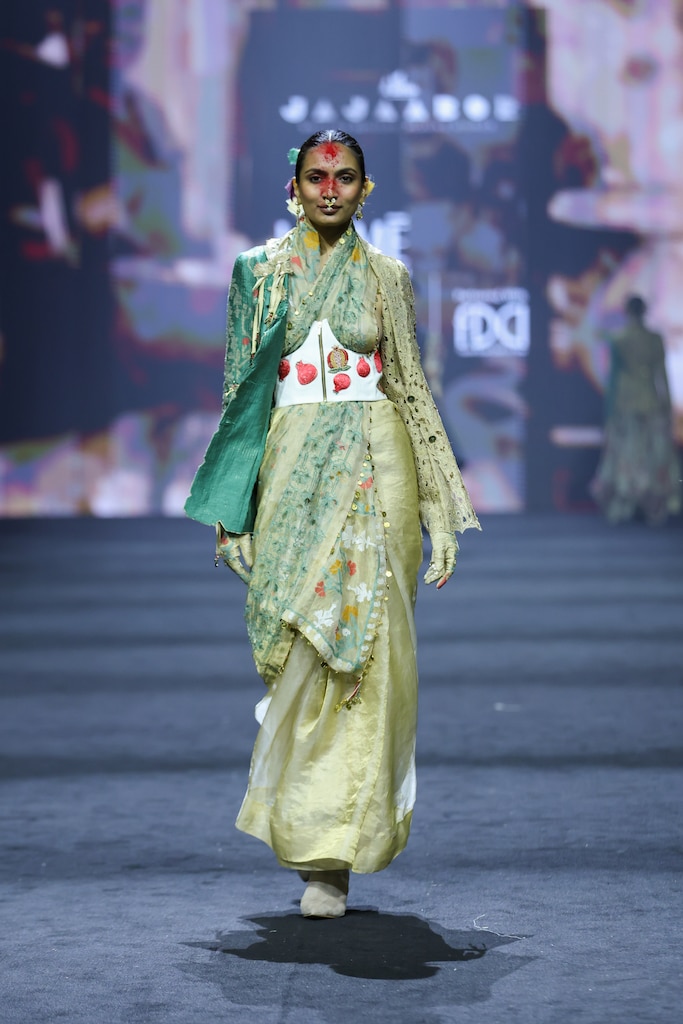
There are florals and then there are Jajaabor florals that the brand flamboyantly showcased at Lakmē Fashion Week 2026. The collection – Calcutta • Kolkata – paid a visually rich homage to the city’s distinctive soul that has remained unchanged over many many decades. While strong vermilion smeared faces marched down the runway, the audience were captivated by the silhouettes that displayed a harmonious mix of structure and fluidity. The designers played with different fabrics and their natural shape, seen across draped looks, jackets, layered looks and skirts that are inevitably going to become the biggest trend this spring/summer. In a candid chat with First Look, the designers behind Jajaabor, Kanika Sachdev and Neelanjan Ghosh take us deeper into the realms of creating a lineup that reflects the modern ‘Calcutta’.
FL: Calcutta • Kolkata feels deeply personal and rooted in memory. How did your own experience of growing up in Kolkata shape its narrative?
NG: Born and brought up in a middle-class Bengali household in Calcutta, I grew up with certain values that quietly shaped the person I am today. I left the city thirty years ago, and in that time, Calcutta became Kolkata. Despite the change in name and the passing of decades, the spirit and essence of the city remains remarkably unchanged. Perhaps I can see this more clearly than many others, because I have known both versions – the Calcutta of my childhood and the Kolkata of today. What some perceive as a reluctance to move forward, citing slower growth, infrastructure, or development compared to other metros, I see as a deep-rooted commitment to culture and heritage. This is the only city I know where stopping a stranger for a spontaneous conversation feels natural, even encouraged. While other cities have carved out distinct identities – Mumbai as the financial capital, Bangalore as the IT hub, Delhi as the party capital – no other city celebrates life quite like Kolkata.
I have experienced all of this firsthand, shaped by my complicated love-hate relationship with the city. And perhaps that is why, when it came to decoding Kolkata while building this collection, it felt instinctive, and almost inevitable.
FL: You describe the transition from Calcutta to Kolkata as continuity rather than change. How did you translate this idea into the design language of the collection?
NG: Design, for me, is always a balance between intent and instinct. While my intent was to create something deeply rooted in culture yet modern and edgy, my instinct kept urging me to add those subtle details that bridge the ‘old Calcutta’ and the ‘new Kolkata’.
The reinterpretation of Jamdani weaves into our own surface textures, and using them to shape contemporary, edgy silhouettes, is one such expression. If you look closely at the pieces, you’ll discover many of these nuanced details. I consciously brought together every element I envisioned to reflect the seamless passing of the baton from Calcutta to Kolkata; that was the intent. But when it came to actually assembling these elements, it felt almost like muscle memory, something instinctive and difficult to explain. I suppose that instinct is what ultimately made it all come together.
FL: The interplay of fabrics, from organza and tissue to denim, creates an interesting tension between delicacy and structure. What guided these material choices?
KS: At Jajaabor, the idea of dichotomy and duality lies at the heart of our design language. We do not claim this philosophy as something new or exclusive to us; it is, in fact, a fundamental truth of existence. The universe itself is shaped by contradictions, a balance of opposing forces that we encounter every day, even in the most ordinary moments. Through our work, we simply attempt to draw attention to this ever-present paradox. From a technical perspective, our journey has also been deeply rooted in mastering contrasts. We have spent considerable time exploring how to create structured silhouettes using inherently soft and fluid natural fabrics such as silk chanderi, tissue, and organza. What better way to interpret and celebrate duality than by bringing together contrasting textiles – materials that seemingly oppose one another– and transforming them into something that exists in complete harmony?
FL: The influence of figures like Satyajit Ray and Rabindranath Tagore is subtle yet present. How do you translate such cultural legacies into a contemporary design language?
KS: We wanted to keep it simple. As a ready-to-wear brand, we were deeply inspired by the intellectual richness of creators like Satyajit Ray, Mrinal Sen, and Rabindranath Tagore. Their work carries immense depth, and we were conscious that directly interpreting it into fashion could risk feeling reductive, or even disrespectful. Instead, we chose a different approach: to inform, not reinterpret.
In a time when awareness of such cultural figures is often limited, especially beyond Kolkata or Bengali communities, we saw an opportunity to spark curiosity. Many people know Satyajit Ray as a legendary filmmaker, but fewer know that he was also an illustrator, writer, calligrapher, and composer. The same creative multiplicity defines Tagore. Our designs draw from simple, recognizable elements within their body of work, incorporating them as subtle, almost kitsch details. These elements aren’t meant to explain their legacy but to start conversations. So when someone asks, “What does this mean?” – it opens the door to something larger: a discovery of the vast, multidisciplinary brilliance of these artists, beyond the brief labels they’re often reduced to.
FL: As this collection comes to life on the runway, what do you hope people take away from your interpretation of Kolkata?
NG: When Balenciaga releases distressed sneakers, the “worn out” look is reframed as intentional, curated imperfection, something to be admired because it’s been validated by design, price, and branding. The same visual language – decay, irregularity and age – gets celebrated when it’s controlled and commodified.
But when a real place like Kolkata embodies those very qualities organically – its peeling walls, dense histories, chaotic rhythms – it’s often dismissed as neglect rather than character. The difference isn’t aesthetic; it’s narrative. One is marketed as artifice, the other is lived reality. Kolkata’s “unpolished” state isn’t a failure to modernise, but a refusal to flatten itself into a generic, hyper-sanitized urban identity. In a world chasing glass facades and algorithm-friendly skylines, Kolkata resists becoming interchangeable. And that resistance has texture: a layered cultural memory that hasn’t been erased for uniformity, a slower, more human pace that coexists with chaos, a kind of inclusivity that isn’t engineered but has evolved over time.
Of course, there’s tension here. Romanticising decay can sometimes overlook real issues – aging infrastructure, economic stagnation, or quality-of-life concerns. The challenge is separating authentic character from avoidable hardship. A city shouldn’t have to suffer to remain soulful. Not all value lies in polish, and not all progress needs to look the same. Kolkata can be experienced less like a “problem to solve” and more like an artwork to engage with. It can be accepted as a place that resists easy interpretation, yet continues to provoke, unsettle, and endure.
“Let the city be” is not a rejection of progress – it is a call to redefine what progress should mean.