


‘Dabu’, Anavila’s Spring-Summer 2023 showcase, opened the Atelier on Sustainable Fashion day at Lakme Fashion Week (LFW) in partnership with Fashion Design Council of India (FDCI). Inside the world of the linen queen and sari trailblazer, Anavila Misra, as she manipulates the volume of a six-yard to create a structure in fluidity.
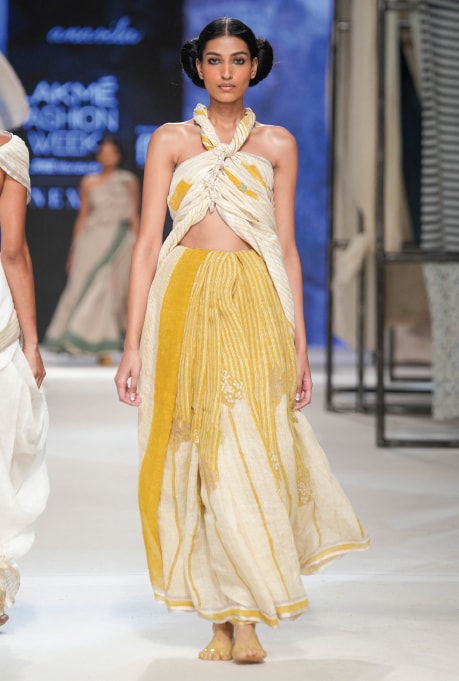
This season, textile-based label Anavila pays homage to Dabu-an ancient mud-resist hand-block printing technique from Rajasthan, the origin of which traces its history back to about 675 AD. Dabu, which comes from the Hindi word ‘dabana” or press, owes its labour-intensive lineage to women’s labour involving several stages of printing and dyeing. The immersively slow process of this surviving village handicraft practised in several rural areas of Rajasthan is reminiscent of a deeply sustainable practice, which has been sustained by honouring local resources-mud, gum, lime and waste wheat chaff. The collection is symbolic of the grace of the feminine experience with nature, as the collection note penned by fashion journalist and sustainability activist, Bandana Tewari, brings to focus. In pre-colonial India, saris were worn without blouses and petticoats-voluminous and diaphanous. In Misra’s draped homage to the craft, the sari comes alive in its undiluted form-often unrestricted by modern accoutrements of style- zippers, buttons or belts-as the uncut and unstitched fabric, speckled by Dabu motifs, flows into the vessel that is the body. In rekindling its bond with the body, the sari thus becomes the river of life, untrammelled and feminine in its flow, creative energy and boundless source of sustenance. Sharing her thoughts on conscious consumption, the Mumbai-based designer says, “Dabu is about creating beauty through mud. This collection brings forth the relationship between not only the art and the artisan, but also a deep, symbolic bond between human beings and the earth they stand on. Mud teaches us that life begins from the ground-up, that a tree does not grow from the leaves but from the roots embedded in mud. It is full of nurturing minerals that feed the soil and soul. Mud is our healer.” Steeped in a palette of natural dyes of ivory, ochre, sage green, indigo, madder, kashish and black with a luxurious presence of gold and silver-gently washed out by the sun-the saris come alive in a range of fluid florals and architectural geometry, wherein the motifs and detailing such as a vein-like effect are derived from the natural surroundings of local flora and fauna. This collection is, in essence, a play on the six-yard sari and how much it can be manipulated with volume. Sometimes free-flowing, sometimes restricted, it stirs the imagination of the wearer and her relationship with a 5000-year-old drape. The artistic intervention lies in the twisting, knotting, and layering of the drapes, which gives each garment their unique shape and silhouette. “Here you see the alluring contradiction in the sari-the very fluidity of it allows a sense of structure to thrive,” stresses Misra.