


As Ekaya Banaras clocks in a decade in the handwoven couture trail of India and beyond, Palak Shah unearths some gems from her priceless brand book.
Meet Palak Shah, the new-age disruptor who took over the challenge of giving a new voice and identity to an already well-established family textile business. The result? Ten years of yards and yards of innovation and interventions making patrons proud to “invest in India-proud design houses,” and in turn, transforming the way textiles have been traditionally woven, worn, presented and sold. Whether it has been about innovating on the loom or experimenting with the luxury handloom sari, it is to Shah’s vivid imagination and team play, as she terms it, that classic Banarasi textiles have been reinterpreted in “ceremonial ensembles with couture finesse as well as premium prêt separates”. Read on to discover the ethos of Ekaya Banaras as Shah talks about the game of entrepreneurship, the principles of sustainability and more.
(Edited excerpts)
FL: As an Indian label revolutionising the Banarasi weave, how would you define the 10-year milestone?
PS: The last 10 years of Ekaya have been incredibly significant on different levels – from initiating a cultural dialogue about our handwoven Banarasi weaves to lending a new gravitas to our weavers and craftsmen, to pushing the envelope by crafting newer silhouettes, we managed to change the perception about how we view our traditional textiles. In turn, we believe we have been able to redefine the timeless Banarasi sari, inculcate sustainable ethos and instil pride in our patrons about investing in India-proud design houses.
FL: What have been your learnings and rewards as an entrepreneur, who took the risk of giving a new voice and identity to an already well-established family textile business?
PS: It’s been a great learning curve and immensely satisfying as with each campaign, we managed to send out a powerful message. I’ve stayed true to our core values of respecting our traditional ethos while experimenting. I’ve also managed to branch into newer markets and discover new customers, who’ve appreciated our relentless push on innovation. From crafting ceremonial ensembles with couture finesse, to creating a niche with premium prêt separates, which can be mixed and matched effortlessly, it’s been a journey to redefine the paradigm.
FL: From identity wear to customary celebratory wear, the Indian sari has passed through several transitions including redundancy for the urban working woman or fading into oblivion in the face of Western wear. Where does the sari stand today and to what consumer base does it appeal to and why?
PS: Sari is India’s answer to an haute couture dress. Nothing rivals the magic of a handwoven Banarasi virgin yardage as it’s a timeless heirloom collectible. I highly doubt that it’ll ever fade into oblivion as I see new-age brides ditching exaggerated ensembles in favour of a classic handwoven silk or georgette sari. The sari is a closet chameleon and can be styled with multiple draping techniques. In our ‘Ambush’ campaign, we presented a new and playful iteration of the sari, which elicited an overwhelming response. Besides, it’s season-neutral and remains impossibly relevant.
FL: Talking about Banarasi textiles, what have been the brand’s research, development and innovation to boost demand and preserve artisanal talent?
PS: Our artisans create and nourish our products; it has been our mission to empower them. We’ve created an ecosystem where they are duly recognised for several hours of hard work that they put into each piece. Every collection underscores a specific weaving technique and there’s a powerful play of weave. Thanks to our pool of artisanal talent, every Ekaya campaign evokes a new visual vocabulary – from a play of vivid colours to ingenious surface texturing.
FL: You have often spoken about presenting a wearable product, especially an Indian weave that is being revived. Could you share some insights into selling handlooms as luxury 101?
PS: Luxury for Ekaya is something which is personal and can’t be defined in limited words. It’s something which is felt, you breathe and live in it. For us, our Indian weaves are heirloom collectibles, works of art – to be treasured, worn, restyled, upcycled and passed on. We’ve upheld the values of responsible, conscious, democratic and approachable luxury. With each of our campaigns – whether it’s ‘Sakura’, ‘Ambush’ or ‘Kashi in The Clouds’ – we’ve put the Banarasi brocade on a pedestal.
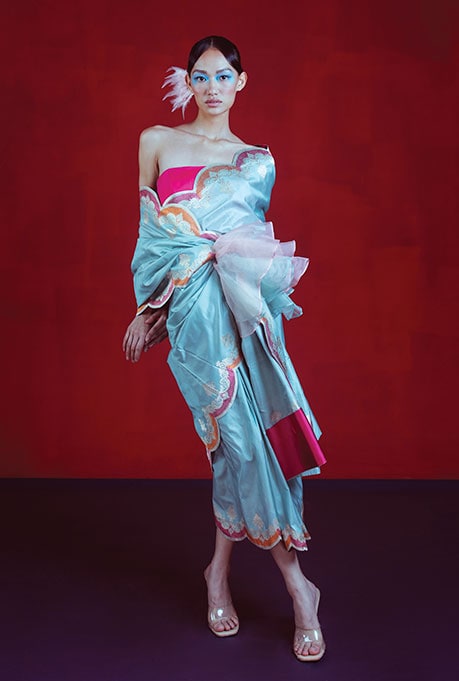
FL: What are some of the most emerging palettes, silhouettes, motifs in the Indian handloom lexicon?
PS: Weaving techniques like rangkaat, kadhwa, cutwork, embossing, satin tanchoi and multi-meena are having a moment at Ekaya. Moreover, I see ornamental Victorian motifs, art jaal work and ombre hues making an impact this season. Lehenga skirts and saris with scalloped borders will be the key silhouettes for ceremonial outings.
FL: As a female entrepreneur, what would you like to say to aspiring women – both legacy and first-time – entrepreneurs in the Indian fashion space?
PS: Stay true to who you are and cultivate a work culture steeped in your own values. Your product should reflect your core beliefs. Have an original point of view and innovate constantly without compromising on your brand’s DNA.
FL: What’s next?
PS: We plan to branch into new markets and product categories.